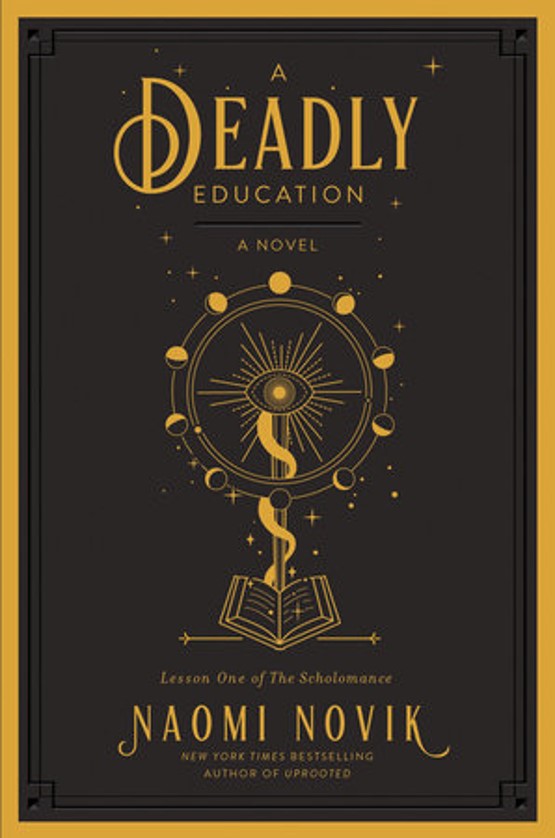
At a glance
El is an anti-social loner, and destructively powerful. She has worked to survive her magical education at the Scholomance with stubborn sarcasm and alternative angst. Graduating requires alliances, and this is the last year she can build those relationships. She went in with a plan, and she means to follow it.
But when the school hero, Orion Lake, insists on saving her, El finds everything she believes about herself, the people around her and the school itself upended.

FANTASY, CONTEMPORARY FANTASY, COMING-OF-AGE, BILDUNGSROMAN
A Deadly Education is…
a masterclass of how to reveal information to the reader when the protagonist isn’t new to the world, written in the 1st person perspective, past tense. It is the first book of THE SCHOLOMANCE trilogy.
The frequent attempt to compare this trilogy to Harry Potter is lazy, the trilogy is in better company with Lev Grossman’s THE MAGICIANS trilogy. The depth of trauma and issues like drug abuse aren’t explored in this book, but the tone is similar—this is not an inconsequential romp made for children. At least I can’t remember Harry using quite so many four-letter-words to describe fellow students the was El does, and enthusiastically.
If you are familiar with Novik’s other stories, you’ll know to expect the influence of European folklore. What you might not expect is the vast roster of creatures, called maleficaria in the series inspired by folklore, classic fantasy, TTRPG and card game monsters, and Science Fiction constructs.
The 13 chapters glide by, paced to perfection with a story structure subtle enough that you might not realise it is there at all.
Although there is an explanation for certain Americanisms in the school language, semester vs term, exams vs finals, junior year vs 3rd year, proctor vs invigilator,1 it remained jarring until the end of the 2nd book for me.
A WORD OF WARNING: do not look up the Maleficaria to see fan art and the like. I looked up what a maw mouth looks like, to see if the image in my head was accurate and google auto complete had the biggest spoiler from book three.
my favourite characters didn’t seem distinct, but became well established
Review
The first few pages throw the reader into a burst of action, with a fistful of worldbuilding, switching between what is happening now and the setup, which confused me so intensely that by the time I understood what was happening I had to start over the chapter. It was clearly written, I just prefer not starting a story with this kind of action.
El is a strong protagonist from the first sentence and I don’t think it is possible to not like her. Her flaws are endearing rather than annoying, she has an independent mind, and well reasoned actions. The reasoning is sometimes questionable, but that is how we avoid her becoming frustrating like many protagonists do when written in 1st person.
Other characters stand out, but to describe them would spoil the development of the story. To begin with many of my favourite characters didn’t seem distinct, but became well established by the halfway point. Don’t mistake this as a failure of the writing, it is effective in expressing the change in our protagonist.

They don’t like me. No one does, except mum.
Page 12
Although the characters feel very true to life and as realistic as any fictional person ever does, they do suffer from the “floating teenager” problem. They float between mid-teens and early twenties. I can understand the point of showing the Scholomance students as socially and emotionally underdeveloped, but that is as much justifying a flaw than it is interpreting subtext.
The well metered pacing never feels like it is being forced by the heavy hand of the author trying to hit the right emotional beat. That isn’t to say the story does not follow a story-structure readers are familiar with, but that the well-practised prose does not make it obvious.
Affecting moments are well earned by the final third of the novel, and they solidified my feelings for this story. The anguish and pain are made more intimate by our closeness to El—in her perspective they are deeply cutting.
One of those moments comes after a scene which was difficult to read [I suggest you apprise yourself of the trigger warnings for this book if you need to know them]. From this scene we get the best use of the “I’ve gotta keep this information to myself, even though life would be easier if I told someone what I know” trope. It was the first time where I could appreciate their position to not scream it for everyone to hear and revelled in the healthy frustration that they didn’t.
The humour comes in the form of curmudgeon sarcasm for the most part, and becomes an intimate aspect of the reader’s relationship with El.
The way El is separated from her Desi heritage, from her Welsh community and from the world is the encapsulation of her key character flaw
The jarring Americanisms have a (mostly) coherent explanation, but I failed to find it satisfying. Having the school years referred to as Junior and Senior was particularly jarring. The talk of honours classes and valedictorian added to this feeling. Imagine the way Sex Education mixes a British setting with distinctly American dressing.
This in-between place, set in a place outside of the physical universe, also make the reveal that the protagonist is Welsh a little surprising. I can’t remember any specific way she is characterised as Welsh in the first book, but in the second book some lexical choices correct it. This could be the first time since the mid-00’s that a Welsh character has been allowed to say more than two sentences without jamming “Lush” into the fray.
That isn’t to say the author has not done her research on Britishness as an experience common across the island of Great Britain, with good references to things like Blue Peter, but it feels generalised. I don’t believe my Welsh family and friends would recognise this character as Welsh until it is stated that she is.

I love having existential crises at bedtime, it’s
Page 181
so restful.
The same might be said for her Desi heritage. Quite early on the experience of being shunned by people is left vague; are these people racist, or do they feel the destructive magic inside her? This question is explored in book two a little and is directly addressed in book three in ways I found to be interesting.
I am sure an author with a background more closely aligned with our protagonist would explore this in a deeper, truer, way. But I appreciate that it wasn’t ignored. The way El is separated from her Desi heritage, from her Welsh community and from the world is the encapsulation of her key character flaw brought about by her father’s sacrifice. This was the best way to include this topic within the story and hopefully in the upcoming film adaptation, directed by Meera Menon, we will see this portrayed in an even more impactful way.
The themes of the entire series, beginning in this book, are enjoyable as an adult. But as a teenager I might have internalised that the mark of a true friend was one accepting of my true self. I might have even learned to temper my sarcasm a little earlier than I did.

But the only chance they’re really giving us is
Page 183
the chance to be useful to them.
Final Thoughts
If you are looking for something cosy, or at least without stress, or a new Harry Potter, this book is not for you. If you are any kind of outsider, not just angsty and goth/metal/emo, you will easily identify with El the protagonist.
As touched upon earlier, I think this series brings together my favourite parts of THE MAGICIANS by Lev Grossman, KINGKILLER CHRONICLES by Pat Rothfuss and THE BLACK MAGICIAN trilogy by Trudi Canavan. All three might feature magic schools, but that is not the aspect they share.
- Grossman’s magic school and wider world are dark, where adult mistakes have adult consequences.
- Rothfuss gives us a protagonist who must use their determination, intelligence and quick wit get them through the worst of their scrapes.
- Canavan uses an outsider, cut off from what is familiar, to explore surviving in a strange system and respect for a dangerous power.
All three rely on finding a new family, building something to hold you up and fighting loneliness, or aloneness. El might not realise that is the point of her journey in this book, but from page 12 it is clear to the reader.
This story earnestly shows not merely finding your people, and a community, but to fall in love with it. To draw it in to your person, binding you to it.
But what this novel does best is the development of the side characters, which is less superficial than some entire series accomplish. At no point is El flattened to explore the other characters and that is rare to see.
The last sentence made me break my 2024 Reading Rule to wait six months before beginning a sequel.2 But the final sentence destroyed my impulse control and I had to move straight on to the second book.
The playfulness, between the main group of characters, and the theme of discarding loneliness are what has remained with me since reading this novel.
As much darkness as their may be, this novel ushered me back towards joy and satisfaction.
A Note On Language
Online spaces have this series tagged as YA. I suppose it is suitable for that age range in terms of themes and subject matter. Although one scene in the library made me emotional enough that I had to put the book down for a few hours.
The accurate use of swearing by teenagers is the only concern I imagine a parent might have in allowing their child to read this series. But in reality, your children are using all these words when out of your company.
Have you read A Deadly Education? Let me know what you thought in the comments below, or leave a link 🔗 to your review so I can check it out.
Soundtrack
- Alexisonfire — discography playlist
- Things Left Unsaid — Things Left Unsaid (2024)
I ended up listening to the Things Left Unsaid self-titled album over 74 times whilst reading this trilogy and they are both intimately bound in my mind. I hear one of the songs and I can remember scenes from the books. I expect if I re-read these books one day it won’t feel the same without this album as the soundtrack.
Uniquely for this coupling, the songs fit the themes of the books. Even a little prosaically, the lyrics reflect events in the later books. Read my review of the album here [review incoming]
- Not an Americanism, but invigilator is ubiquitous in the UK, so it felt out of place ↩︎
- After finishing a series I often experience a reading slump and deflation which makes me hate everything else I attempt to read. This rule was an attempt to curtail that, and I was lucky it didn’t happen after completing this trilogy ↩︎
 L N Sanby